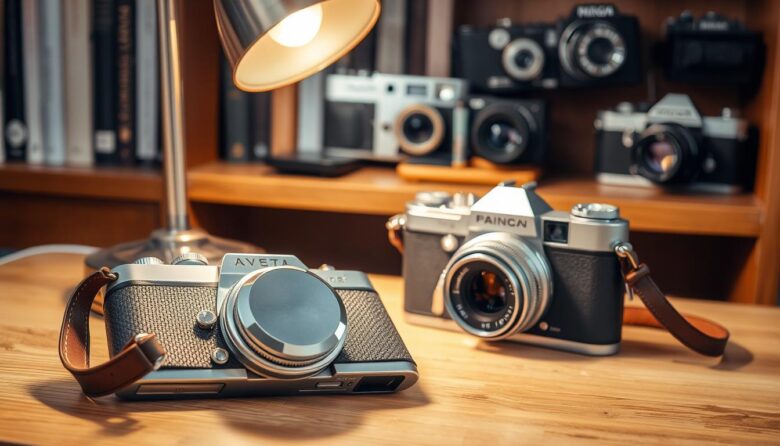
The return of film feels less like a fad and more like a reset for people who love the tactile side of photography. Slow, deliberate shooting brings the joy of holding a negative that can live in a drawer for years, not just a file in the cloud.
A recent community poll of over 20,000 views placed the Hasselblad 500 series at the top of the best film cameras list, followed by the Nikon F3/F3HP, Leica M6, Olympus OM-1, and Nikon FM3a. That vote echoes a broader comeback, with brands like Leica even reissuing classics since 2022.
This guide will help you decide which camera format fits your goals. We cover picks by budget, 35mm to medium format film, where to buy safely, how to stretch a roll, and which systems tend to hold value over years. If you’re looking for a clear list of use cases and smart buying tips, you’ll find hands-on insights and crowd favorites to help your next purchase feel confident and right for your craft.
Why film is back: the appeal of analog in the present day
In a world of instant previews, film offers a deliberate pace that many photographers now crave. Waiting for development makes each photo feel more present and unedited.
The act of loading, winding, and hearing the shutter roots you in a particular time and place. That tactile routine forces slower choices and sharper composition.
Negatives act as physical archives. They give images longevity and a tangible proof that many miss in a digital-only workflow.
Each film camera and stock carries its own character, so the final photo often has a human warmth that is hard to replicate. Minor quirks and surprises are part of the charm.
Modern labs and mail-in services make it simple to get scans fast while keeping the hands-on process intact. Beginners and seasoned shooters alike are joining local shops and online groups, making film a social comeback across the world.
This guide pairs that appeal with practical steps so you can get consistent, great results from film cameras and enjoy the craft for years to come.
Quick picks: best film cameras by use case and budget
Budget and purpose should steer your next purchase—here are fast picks to get you started.
Under $100: half-frame and simple point-and-shoot options
Great starter options include the Kodak Ektar H35, Olympus Pen EE-3, and Canon AF35M. These keep costs low per roll and are easy to carry.
Half-frame bodies like the Ektar H35 and Pen EE-3 double your exposures, so you get more shots for your money. The Canon AF35M uses AA cells, which makes power simple to replace.
$100–$300: enthusiast SLRs and compact rangefinders
In this range, the Nikon FE/FE2, Canon AE-1 Program, and Pentax K1000 stand out. They offer growth paths—from aperture priority to full manual control.
These models are repairable, have lots of lens options, and help you learn exposure without costing a fortune.
Premium picks: icons that hold value and inspire
If you want systems that age well, consider the Hasselblad 500 series, Leica M6, Nikon F3/F3HP, Contax T2, or Contax 645 with the Zeiss 80mm f/2. These pieces often retain value and reward consistent use.
Prioritize condition, available service, and return policies when buying used. Pick features that match how you shoot—aperture priority, full manual, or autofocus—to avoid paying for functions you won’t use.
A great camera is the one that gets you out shooting. Choose by everyday carry, learning goals, or a long-term system, and focus on condition and lens support for real-world ownership.
How to choose the right analog camera for you
Choosing the right film setup starts with knowing how you like to work and what you want from each shot. Think about speed, control, and the final look you want on the negative.
Manual vs. point-and-shoot: control, learning curve, and speed
Manual SLRs give full control of aperture and shutter speed and help you learn exposure. They reward practice but take time to master.
Point-and-shoot models are quick, reliable, and great for travel. Many fully automatic examples use AA/AAA cells, so batteries are easy to source.
For learners, aperture-priority models are a sweet option: you pick depth-of-field while the camera sets shutter speed.
Film formats and battery realities
35mm is convenient; half-frame doubles shots (about 72 from a 36 roll) for economy. Medium format—645, 6×6, 6×7—delivers larger negatives and richer tonality for portraits and prints.
Some classic bodies need mercury-cell voltage workarounds. Selenium meters (seen on the Olympus Trip 35 and Pen EE-3) avoid batteries entirely. If you’re looking for reliability, buy from reputable shops or vetted sellers on eBay and check return policies.
Practical buying tips
Start with one reliable body and a solid lens. Consider your focus method—zone, rangefinder patch, or SLR screen—as it affects keeper rates. Jot down must-have features so specs don’t distract you from how you’ll actually shoot.
Best 35mm film cameras for beginners and enthusiasts
Choosing a first 35mm body is about finding clear controls, solid support, and lenses you can keep using as you improve.
Canon AE-1 Program and Rebel series
The Canon AE-1 Program is a quintessential starter. It offers full auto exposure plus manual focus so you can learn fundamentals without getting lost.
Rebel models like the G and K2 add autofocus and scene programs. They’re ideal for family events or travel when speed and convenience matter.
Nikon FE2, FE, F3/F3HP, FM3a
The Nikon FE2 and FE let you grow with aperture priority and reliable metering; the FE2 adds a multiple exposure lever for creative use.
Pro-grade bodies — the F3/F3HP and FM3a — are built to last for years and handle heavy use when serviced properly.
Pentax K1000 and PC35AF-M
The Pentax K1000 is a student favorite for mastering manual exposure and focus. It’s simple, durable, and pairs well with a 50mm prime.
For travel, the Pentax PC35AF-M is a compact f/2.8 point-and-shoot that fits a daypack and shoots well on the go.
All these bodies have lens support and service options, so beginners avoid dead ends. Start with a 50mm prime to learn aperture and composition affordably, and watch a short YouTube video to see controls before you buy. Always check meter, shutter, and light seals, and confirm return policies when purchasing used.
Medium format standouts for portraits, detail, and wow-factor
Big negatives yield big detail — and that payoff is why many photographers choose medium format. These systems bring richer tonality and a signature look that lifts a single image into a print-worthy moment.
Hasselblad 500 series and SWC/M
The Hasselblad 500 series topped a large audience poll for best film cameras. Its modular V-system shares bodies, backs, and lenses, so parts and accessories are easy to mix and match.
The SWC/M is a fixed-lens 6×6 super-wide famed for world-class image quality. Landscape and architecture shooters prize its clarity and field of view.
Pentax 67/67II and Contax 645
Pentax 67 and 67II, paired with the 105mm f/2.5, deliver creamy separation ideal for portrait work, though the system is large and heavy.
The Contax 645 with the Zeiss 80mm f/2 made a name among wedding photographers for its distinct rendering and autofocus convenience.
Rangefinder medium format for travel
Mamiya 6/7, Fuji GF670, and the Plaubel Makina 67 offer lighter, quieter kits with big negatives. They trade some close-focus ability and toughness for portability.
Plan for regular CLA service, watch storage conditions, and think about frames per roll (10 on 6×7 vs 16 on 645) when you’re looking at shooting rhythm and cost.
Analog cameras
Handling a film body feels intentional: each click and wind asks you to slow down and decide. Expect a hands-on routine that teaches exposure and build confidence faster than relying on auto modes alone.
Controls and metering
Many classic camera bodies let you set shutter speed and aperture manually or use aperture-priority. That mix is easier to learn than it sounds with practice and a simple cheat card in your wallet.
Focusing and viewfinders
SLRs use a focusing screen, rangefinders use a split-image patch, and point-and-shoots often rely on autofocus or zone focus. Try a static subject to see how depth of field changes as you stop down.
Practical tips
Meters vary: some need fresh batteries, others use selenium cells and need light to function. Meter for shadows on negative film to hold detail, and accept slight overexposure for many color stocks.
Consistent handling builds muscle memory so your eye stays on composition. There’s no single right way—choose the approach that keeps you shooting often and enjoying each photo.
Half-frame advantages: double the shots, half the cost
Doubling exposures per roll makes half-frame an instantly practical choice for everyday shooting. Half-frame bodies like the Olympus Pen EE-3 and Kodak Ektar H35 turn a 36-exposure roll into about 72 frames, so you shoot more for less.
Compact, economical fun
Here’s the math: if film costs ~$10 and dev/scan ~$15, a 36-exposure roll runs about $0.70 per photo. Half-frame cuts that to roughly $0.35 per shot. Over months of shooting, that savings adds up fast.
The Pen EE-3 uses a selenium meter and needs no battery, which is perfect for low-prep days. The Kodak Ektar H35 is a fixed-focus point-and-shoot film camera that’s lightweight and easy to carry.
Half-frame negatives are smaller, but many shooters love the look for sharing and small prints. Rolls do take longer to finish, so plan ahead if you need fresh film for an event.
Stick to versatile color stocks for consistent results across a long roll, and rely on zone or fixed-focus designs to keep shooting simple—almost like a disposable, without the waste.
Seeing a large set of scans come back from the lab is motivating. Watch a short youtube video before your first outing to practice loading and metering with a half-frame model.
Point-and-shoot favorites for everyday carry
Everyday carry works best when your camera is simple, reliable, and fast to deploy. Point-and-shoot models give you sharp results without technical fuss, so you shoot more and worry less about settings.
Canon AF35M — budget-friendly and dependable
The Canon AF35M is a fully automatic, AA-powered model that surprises with crisp output despite a plastic build. It’s ideal for travel or daily use when you want consistent photos and easy battery swaps.
Contax T2 — premium pocket performance
The Contax T2 pairs a high-quality fixed lens with a compact body, making it a favorite among style-forward photographers. If you buy one, budget for a protective case to keep condition and resale value high.
Fuji GA645 — medium format in a set-and-shoot
The Fuji GA645 brings 16 shots per 120 roll and autofocus in a travel-ready package. It’s perfect for portraits and city scenes when you want medium format quality without manual fuss.
Fixed-lens designs simplify decisions and help you focus on timing and framing. Before buying, check autofocus behavior, flash options, light seals, and film advance to avoid surprises. Pair these bodies with versatile color film so mixed light stays forgiving. Ultimately, the best everyday carry is the camera you’ll bring everywhere—and these models make that easy.
Rangefinders and SLRs: which viewfinder experience fits you
Deciding between a rangefinder and an SLR comes down to how you like to see and nail focus in the moment.
Rangefinders use a bright patch to align the subject and reward careful focus. They are often smaller and quieter, which makes them great for street and travel work.
SLRs show exactly what the lens sees through the viewfinder. That makes learning aperture and shutter speed more intuitive because you preview depth of field and framing directly.
Think about handling: SLRs have mirror slap and a different shutter feel. Rangefinders deliver a gentler shutter action and a low-profile rhythm. Both affect stability and how you time shots.
Models like the Canon QL17 GIII, Canon AE-1, and Nikon F3/FM3a give direct control and satisfy mechanically. Lens ecosystems differ, so consider the available glass if you plan to build a kit over time.
Try both types if you can. Pick by subject—portraits, street, or landscapes—and choose the system that inspires you to shoot often. That spark matters more than any spec.
Lenses that make the difference: sharpness, character, and budget
A single lens often defines the look you chase more than the body you mount it on. Good glass can lift any camera and give your film photos a signature tone.
Affordable primes and flexible zooms
Start with a 50mm f/1.4 prime. It blends sharpness, low-light speed, and price, and it teaches composition quickly.
Underrated zooms are useful for travel. They trade max aperture for flexibility and often save money while covering many focal lengths.
Legendary portrait glass
The Contax 645 with the Zeiss Planar 80mm f/2 delivers a distinct portrait look prized by wedding photographers for its rendering and separation.
Hasselblad H bodies paired with the HC 100mm f/2.2 give a similar vibe and add autofocus to help nail photos more consistently.
Practical buying tips
Build around one excellent lens first, then add 35mm or 28mm for environment shots. Check glass for clean elements, smooth focus, and quick, snappy aperture blades.
Character matters as much as sharpness—choose the rendering that makes you reach for the camera every time.
Film stocks to start with and why they matter
What you load into a roll will steer tone, latitude, and how forgiving your exposures are. Choosing a few reliable stocks early makes learning faster and results more repeatable.
Kodak Gold, Portra 160/400, Pro Image 100: color looks and latitude
Kodak Gold 200 is the budget-friendly, warm option that flatters everyday scenes and skin tones. It handles mixed light well and gives pleasing color without fuss.
Kodak Portra 160 and 400 are the go-to choices for the best film balance of latitude and skin rendition. They forgive slight overexposure and keep highlights and shadow detail tidy.
Kodak Pro Image 100 works great in bright conditions when you want low grain and crisp color. Use it for travel or any time you want cleaner scans from the lab.
When to choose slide or black-and-white for dramatic results
Slide film delivers saturated color and punch, but it needs exact exposure and steady metering in controlled light. Pick it when you want bold, precise results.
Black-and-white stocks simplify decisions and teach tonal control. They remove color distraction so you learn composition and contrast quickly.
Remember: the same camera will render different moods by changing film. Rate color negative slightly lower than box speed for softer contrast and smoother skin. Log which stock and roll you used and ask your lab for sample scans so you can refine choices over time.
Where to buy: trusted sources and what to avoid
A smart purchase starts with trusted sellers and a short checklist you can use in any marketplace. This keeps surprises low and helps you get a working camera that lasts.
eBay, KEH, and reputable resellers
eBay offers wide selection and good prices, but read descriptions closely. Favor sellers with strong feedback and recent photos of the exact item.
KEH and similar resellers grade gear and often include warranties. For higher-value bodies and lenses, this reduces risk and saves money over the long run.
Camera shops vs. thrift stores
Local shops let you test shutters, meters, and viewfinders in person. They may charge a premium, but you get hands-on checks and seller knowledge.
Thrift stores and flea markets can have bargains, but they rarely allow testing. These are gamble buys unless you know how to inspect and repair a unit yourself.
Ask sellers specific questions about shutter speeds, meter function, film advance, and viewfinder clarity before you commit. Prioritize listings that accept returns so you can run a quick roll to verify operation.
Inspect for common issues: light seals, battery compartment corrosion, and smooth focus helicoids. Bring a battery, a spare roll, and a small flashlight when testing in person. Watching a short youtube video on condition checks for the exact model you’re looking to get helps spot red flags.
Value, service, and longevity: getting the most from your money
Smart buying keeps you shooting longer and protects the money you invest in film gear. Choose systems with known parts supply and technician support to reduce downtime and surprises.
Serviceability and modular systems that age well
Modular platforms stretch value. The Hasselblad 500 series lets users swap bodies, lenses, and backs so a single lens can live through many bodies. Some H-series models accept film backs, which adds flexibility over time.
Long-production models like the Nikon F3 enjoyed wide service support and parts, making repairs easier and cheaper. By contrast, electronics-heavy models such as the Contax 645 can carry higher repair risk and cost if faults occur.
Smart budgeting: bodies vs. lenses, repairs vs. replacements
Prioritize great glass: lenses often outlast any single camera and hold resale value. Budget more for lenses if you plan to grow a kit.
Weigh repair quotes against replacement costs. For mechanical models, routine CLA keeps shutters accurate and film transport smooth. Keep a small maintenance fund so minor issues don’t bench your kit.
Buying a well-serviced model with a service history can be worth a modest premium. The best film camera for value is the one you can keep using—reliable, serviceable, and ready to shoot each time.
Ready to shoot: your next steps toward film photography
Start simple: one reliable 35mm camera and a 50mm lens will teach you more than any checklist.
Load a beginner-friendly color stock like Kodak Gold or Portra 400 and buy from a seller that accepts returns. Shoot a full test roll to verify metering and film transport before you expand.
Practice in good light first. Keep short notes on settings and locations so you learn from each scan. Set small goals — one subject or block at a time — and stick to a single lens for a few weeks to build composition and timing.
Watch a friendly blog guide or a short walkthrough video to see loading and metering in action. Share your favorite frames, ask questions in communities, and learn from others’ process.
Thanks for reading, and thanks for exploring film photography. Thanks again — now get outside, load a roll, and make your first images today.